
How many restrooms does a marathon need in East Los Angeles?
Course length and runner count decide the number, but density matters more than raw totals. A 5K with 500 runners needs less than a marathon with 3,000, obviously, but both need restrooms bunched at the start corral, spaced along aid stations, and doubled at the finish chute where everyone lingers. Standard portable toilets handle most of the course. Add at least one ADA accessible unit per cluster, since ADA Standards section 213.2 requires at least 5 percent of clustered single-user units to be accessible, never fewer than one. That accessible unit needs a 60 inch turning circle inside per ADA Standards section 304.3.1, and a clear door opening of 32 inches under ADA Standards section 404.2.3. Race organizers running a certified course in East Los Angeles often pull our how many porta potties do I need guide before finalizing headcounts. If your race also uses staff volunteers on site for setup, OSHA 1926.51(c)(1) governs their toilet ratio separately from runner-facing units, since crew counts as a workforce. We quote off your race map, not a flat number, and we walk the route with you if the course crosses tight residential blocks common in East Los Angeles.
Where should restrooms go on a race course?
Restrooms belong at three points without exception: the start line, key aid stations, and the finish area, where post-race crowding is worst. Placement also depends on truck access. A roll-off dumpster or a bank of toilets both need about 60 feet of straight clearance behind the delivery truck, so start-line staging near a wide street works better than a cul-de-sac. Ground surface matters too: ADA Standards section 302.1 calls for stable, firm, slip-resistant footing, which rules out soft turf for accessible units without matting. If your event needs event power for timing clocks or PA systems, ask about how to brace a temporary power pole; poles need a stable base and guy-wire tension so wind or a jostling crowd cannot tip them, and our temporary power pole service sets that up alongside the restroom layout. Races that close streets for a few hours often add temporary fencing or crowd control barriers around restroom clusters so lines do not spill into the running lane. Courses that run through Monterey Park, 2.7 miles northeast of most East Los Angeles start points, or toward Alhambra, 5.0 miles northeast, should plan restroom stops at each municipal boundary since service crews may need separate access permissions.
What does a race day restroom rental cost?
| unit | duration | low | typical | high |
|---|---|---|---|---|
| standard | event | 200 | 400 | 800 |
| ada | day | 200 | 230 | 400 |
| trailer | event | 2499 | 3500 | 3899 |
| delivery_fee | day | 100 | 150 | 500 |
Most 5K and 10K events in East Los Angeles fall in the standard event range shown above, while marathons with multiple aid stations and a finish-line restroom trailer run closer to the trailer event band. A 4 stall restroom trailer at the finish line handles the post-race rush better than scattered single units, especially for events expecting spectators as well as runners. Delivery fees apply once per drop unless your course spans multiple staging zones. For full pricing logic across durations, see porta potty rental cost or porta potty rental per day. Weekly and monthly race series should check monthly porta potty rental pricing instead of booking single events repeatedly. Water stations along the route may also need handwashing stations, since 29 CFR 1910.141(d)(2) requires soap and towels or a hand-drying device wherever washing facilities are provided, and hand sanitizer alone does not satisfy that. Volunteer aid station crews handling food sometimes trigger OSHA 1926.51(f)(1) washing requirements too, but only where paints, coatings, herbicides, insecticides or similar contaminants are present, not for general water station duty.
Races drawing from Bell Gardens, 6.7 miles south, or Rosemead, 7.4 miles northeast, sometimes route through both cities, and each may set its own rules for restroom placement in the public right of way; confirm this directly with the city rather than assuming East Los Angeles rules carry over. Pico Rivera sits 7.6 miles southeast and comes up often for relay-style courses that cross county lines. For general course sanitation planning beyond restrooms, our construction site services and event restroom rental pages cover overlapping logistics like fencing and lighting. See also festival restroom rental and concert restroom rental for comparable crowd-density math.
How far in advance should I book race restrooms?
Two to four weeks out is typical for East Los Angeles races, longer for marathons needing multiple trailers. Permit confirmation with the city and route finalization both take time, so lock the restroom count once the course map is set, then adjust up if registration surges.
Do runners need an accessible restroom on course?
Yes. ADA Standards section 213.2 requires at least one accessible unit per cluster, with a 32 inch clear door and a 60 inch turning circle inside. Place it at the start, at major aid stations, and at the finish, not just at one spot on the course.
Can restrooms be moved mid-race for a rolling road closure?
Units can be relocated between waves if the course closes in stages, but moving a servicing trailer requires the same 60 feet of truck clearance as the initial delivery. Plan the move window with us before race day, not during it.
What if my race needs emergency restroom replacement?
Call us directly. Our emergency porta potty rental service handles mid-event swaps for damaged or overwhelmed units, which matters most at a finish line where volume spikes hard in a short window.
Should I add handwashing stations at aid stations?
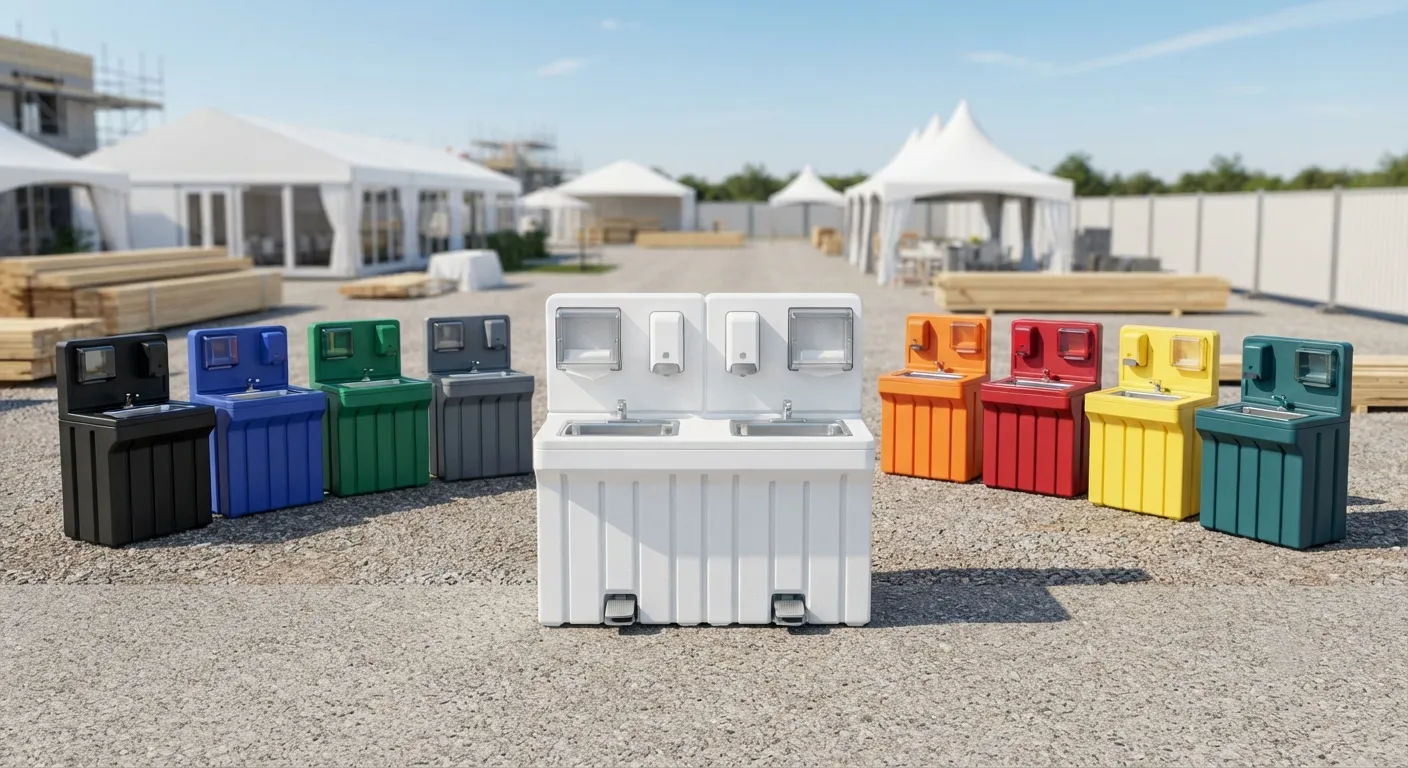
Yes, especially where volunteers handle food or gels. Under 29 CFR 1910.141(d)(2), washing facilities need soap and towels or a dryer, not sanitizer alone. Pair each aid station restroom with a portable sink for that reason.
Next step
Get a delivery date
Tell us the address, the dates and the headcount. We size the order and confirm the route.